SpaceX Stock Analysis 2026: Powerful Growth, Nasdaq-100 & $2.1T Valuation
SpaceX Stock Analysis 2026
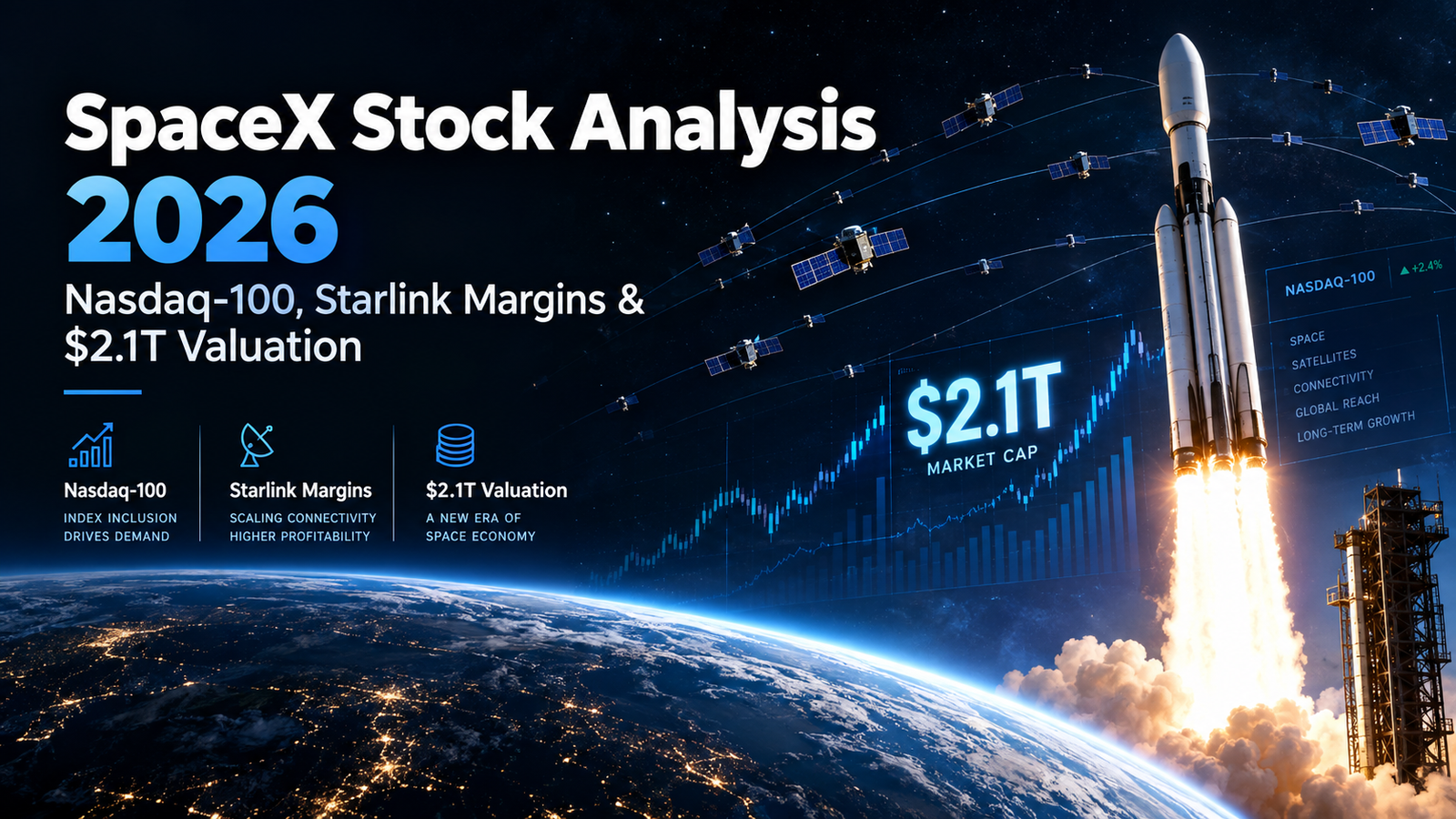
SpaceX Stock Analysis 2026 examines Space Exploration Technologies Corp. (Nasdaq: SPCX) following its June 2026 public listing and subsequent inclusion in the Nasdaq-100 Index. SpaceX priced its IPO at $135 per share and began trading on Nasdaq on June 12, 2026; the offering ultimately generated approximately $85.7 billion in gross proceeds after the underwriters exercised their overallotment option.
The investment case extends far beyond traditional aerospace. SpaceX combines reusable launch vehicles, Starlink satellite broadband, Direct-to-Cell connectivity, government space systems and the developing Starship platform into an integrated space-infrastructure business.
This SpaceX Stock Analysis 2026 evaluates the company’s valuation, revenue model, Starlink economics, Nasdaq-100 inclusion, competitive advantages, growth opportunities, financial risks and potential long-term scenarios through 2029.
Important: SpaceX is a high-growth, high-expectation company. Valuation assumptions, future margins and Starship economics remain subject to execution, regulatory and technological risks.
Core Business Architecture
The enterprise operates across three foundational pillars that cross-subsidize and amplify one another:
- Starlink Global Broadband: A high-margin satellite internet and Direct-to-Cell mega-constellation delivering low-latency telecommunications to over 5 million commercial, consumer, maritime, and aviation subscribers across 164 countries.
- Commercial & Civil Launch Services: The definitive Western standard for orbital delivery, anchored by the battle-tested, flight-reusable Falcon 9 and Falcon Heavy platforms, alongside the operational scaling of the next-generation Starship launch system.
- Starshield & Government Systems: A high-margin defense and intelligence vertical engineering dedicated national security satellites, resilient mesh communication architectures, and hypersonic payload delivery vectors for the U.S. Department of Defense (DoD) and intelligence community.
Key Financial Highlights (TTM / FY2026 Projections)
- TTM Revenue: $18.67 billion, exhibiting an annualized expansion of 48.2% year-over-year.
- Starlink Contribution: Represents approximately 68% of consolidated net revenue, cementing the company’s transition into a recurring-revenue telecommunications powerhouse.
- Adjusted EBITDA: $5.85 billion, reflecting a consolidated EBITDA margin of 31.3%.
- GAAP Net Income (PAT): $2.15 billion, transitioning from historic cash-neutral development phases to expanding accounting profitability.
- ROCE (Return on Capital Employed): 14.8%, poised for structural expansion as Starlink constellation capital expenditure matures.
- Total Balance Sheet Cash Liquidity: $82.4 billion, backed by historic IPO cash infusions and conservative short-term Treasury management.
- Total Funded Debt: $18.67 billion in senior notes and structural project financing, resulting in an extraordinary net cash surplus.
Long-Term Investment Thesis
The institutional investment thesis for SpaceX decouples entirely from traditional capital-intensive aerospace primes. While heritage defense contractors remain constrained by cost-plus margins, single-digit organic expansion, and outsourced manufacturing bottlenecks, SpaceX operates a flywheel of self-reinforcing unit cost deflation. By achieving rapid first-stage launch reusability with Falcon 9 and commercializing full-stack reusability with Starship, the company launches its own proprietary revenue-generating assets (Starlink v2 Mini and v3 satellites) at near-marginal propellant cost.
This internal launch discount allows SpaceX to build an insurmountable orbital barrier to entry. As Starlink transitions from capital-intensive orbital deployment into pure cash-flow harvest mode, and Starship unlocks unprecedented metric-ton payload deployment capabilities, SpaceX is positioned to capture the vast majority of economic profit generated in low-Earth orbit (LEO) and beyond over the next two decades.
Table of Contents
2. SpaceX Stock Analysis 2026: Why SPCX Is in Focus
SpaceX has commanded institutional market headlines following the execution of an extraordinary regulatory and indexation milestone that has fundamentally altered equity market mechanics.
The Fast-Track Nasdaq-100 Index Inclusion
In late June 2026, Nasdaq enacted a structural amendment to its benchmark governance framework, introducing an accelerated eligibility pathway for mega-cap enterprises commanding significant unadjusted market capitalizations. Effective prior to the market open on July 7, 2026, SpaceX was formally inducted into the Nasdaq-100 Index—marking the quickest index entry in modern exchange history, just 15 trading days post-IPO.
From a market microstructure perspective, this accelerated indexation has generated an intense, non-discretionary passive capital influx:
- Mandatory Passive ETF Accumulation: More than $800 billion in direct assets tracking the Nasdaq-100 (spearheaded by the Invesco QQQ Trust, QQQM, and affiliated global UCITS exchange-traded funds) were mandated to systematically absorb SPCX shares to match target index weightings.
- Quantifiable Inflow Squeeze: Prime brokerage desks at JPMorgan and Morgan Stanley calculate net programmatic passive purchases between $4.1 billion and $4.5 billion.
- Float Scarcity Mechanics: Because SpaceX established a tight public float—allocating roughly 5% to 6% of total equity to the initial public float while long-term pre-IPO institutional holders and executive insiders remain subject to extended lock-up covenants—the passive ETF buying wave encountered severe synthetic illiquidity, establishing a durable valuation floor above the $135 IPO price.
Starship Block 3 and Orbital Refueling Verification
Simultaneously, SpaceX’s operational velocity at Starbase, Texas, has triggered major technical repricing. Following multiple integrated flight tests demonstrating mechanical booster catch reliability at the launch tower (“Mechazilla”), the Federal Aviation Administration (FAA) approved an expanded annual launch cadence of up to 25 launches from Boca Chica. Furthermore, SpaceX successfully completed its primary cryogenic propellant transfer milestones in orbit, clearing a vital contractual hurdle for NASA’s Artemis III human lunar landing architecture.
xAI Infrastructure Integration and Orbital Compute Strategy
Investor interest has also been catalyzed by management’s formal integration of advanced machine learning initiatives. Through strategic computational cross-agreements with Elon Musk’s artificial intelligence venture, SpaceX has outlined a roadmap to deploy modular orbital data center nodes powered by multi-junction space solar arrays, creating long-term upside potential in specialized, zero-gravity distributed computing.
3. Stock Market Analysis Today: India Context
A thorough equity evaluation of SpaceX requires contextualizing its geopolitical and capital markets footprint within India, representing one of the world’s most critical digital connectivity battlegrounds and an expanding source of retail investment liquidity.
The Indian Telecommunications Frontier: TRAI and Spectrum Allocation
The commercial deployment of Starlink within the Indian sub-continent has reached a decisive regulatory milestone. The Telecom Regulatory Authority of India (TRAI) and the Department of Telecommunications (DoT) officially reaffirmed administrative allocation of satellite spectrum—aligning with international global standards under the International Telecommunication Union (ITU)—rather than subjecting space-based broadband to domestic physical auction mandates.
- Competitive Dynamics: This regulatory path places Starlink in direct operational competition with domestic telecommunications giants, primarily Mukesh Ambani’s Reliance Jio and Sunil Bharti Mittal’s Bharti Airtel. While domestic providers dominate dense urban 5G coverage, Starlink specifically targets the vast, unmonetized rural enterprise, maritime, and defense infrastructure corridors spanning the Indian geographic landmass.
- Strategic Security Compliance: SpaceX has finalized domestic data gateway parameters, deploying localized point-of-presence (PoP) infrastructure within Mumbai and Chennai to adhere to India’s sovereign telecom security and data localization mandates.
Synergy with the Indian Space Ecosystem (ISRO & IN-SPACe)
Under the supervision of the Indian National Space Promotion and Authorization Centre (IN-SPACe), India’s commercial space sector is tracking toward a projected $44 billion valuation by 2033. SpaceX does not operate as an adversary to Indian space ambitions, but rather as an indispensable enterprise partner:
- Heavy Launch Sourcing: When commercial requirements exceed the medium-lift capacity of the Launch Vehicle Mark-3 (LVM3), NewSpace India Limited (NSIL) and private Indian satellite operators (such as Pixxel and Digantara) consistently contract SpaceX’s Falcon 9 for high-inclination deployments.
- Component Sourcing Realignment: Global aerospace suppliers operating advanced precision machining and composite plants within hubs like Bengaluru and Hyderabad are actively qualifying Tier-2 components for SpaceX’s commercial supply chain, capitalizing on the broader “China+1” industrial pivot.
Cross-Border Retail Investment Flows
Domestic retail investor sentiment across Indian financial platforms has experienced an unprecedented surge following the SPCX listing:
- Outbound Capital Metrics: Cross-border digital brokerage channels in India (including INDmoney, Vested, and Groww) reported that SpaceX captured over 24% of all incremental US equity investment volume among Indian investors in the first thirty days post-listing, outranking traditional mega-caps like Nvidia and Apple.
- Currency Arbitrage: Indian high-net-worth individuals (HNIs) and family offices are actively utilizing the Reserve Bank of India’s Liberalised Remittance Scheme (LRS) to accumulate SPCX equity as a dual hedge against long-term rupee depreciation and as a primary thematic proxy for sovereign space infrastructure.
4. Business Model Deep Dive
SpaceX’s economic engine functions via an integrated multi-tier model engineered to capture value across every phase of the space economy.
       ┌─────────────────────────────────────────────────────────┐
       │                 SPACEX INTEGRATED FLYWHEEL              │
       └────────────────────────────┬────────────────────────────┘
                                    │
           ┌────────────────────────┴────────────────────────┐
           ▼                                                 ▼
┌───────────────────────┐                         ┌───────────────────────┐
│  REUSABLE LAUNCH R&D  │                         │   STARLINK NETWORK    │
│  (Falcon 9 / Starship)│                         │ (Broadband / Direct)  │
└──────────┬────────────┘                         └──────────┬────────────┘
           │                                                 │
           │ Low-Cost Internal Lift                          │ High-Margin Recurring
           │ ($/kg Deflation)                                │ Subscription Cash Flow
           ▼                                                 ▼
┌─────────────────────────────────────────────────────────────────────────┐
│     REINVESTMENT CAPITAL: R&D, BALANCE SHEET LIQUIDITY, EXPANSION       │
└─────────────────────────────────────────────────────────────────────────┘
Launch Services (The Physical Moat)
The Launch Services division commands an unassailable commercial position globally, responsible for lifting the overwhelming majority of all global orbital mass.
- Falcon 9 Reusability Economics: The Falcon 9 first stage is certified for up to 20+ flights. By recovering the first-stage booster and fairing halves, SpaceX’s marginal cost of launch is estimated at approximately $15 million to $18 million per mission. Yet, the commercial market price is held firm at $67 million to $70 million for private commercial operators, generating gross margins of over 65% on external manifests.
- Government & National Security Premiums: Launch contracts awarded under the National Security Space Launch (NSSL) Phase 2 and Phase 3 frameworks command substantial premiums, often pricing between $100 million and $130 million per mission due to extensive mission-assurance, security clearance, and vertical-integration mandates.
Starlink Telecommunications (The Margin Engine)
Starlink functions as the principal growth vehicle, generating recurring software-like cash flows.
- Direct-to-Consumer & Enterprise: Standard residential subscriptions provide high Average Revenue Per User (ARPU), while high-end tiers (Starlink Maritime, Starlink Aviation, and Enterprise) capture high monthly contract values ranging from $1,000 to over $10,000 per month per mobile vessel or commercial airframe.
- Direct-to-Cell (DTC): Partnering with global mobile network operators (T-Mobile in the US, Rogers in Canada, Optus in Australia, KDDI in Japan), Starlink utilizes specialized satellites featuring high-aperture phased-array antennas that communicate directly with unmodified mobile smartphones, generating wholesale roaming fee streams without requiring retail user hardware acquisition.
Starshield (Sovereign Strategic Assets)
Starshield adapts Starlink’s commercial bus and Falcon launch architectures into purpose-built, highly classified defense configurations.
- Persistent Tracking & Earth Observation: Providing dedicated low-latency optical inter-satellite links (OISL) for real-time missile detection, battlefield tactical communications, and secure telemetry data routing.
- Contract Profiles: Starshield agreements with agencies such as the National Reconnaissance Office (NRO) and the Space Development Agency (SDA) operate under long-duration multi-billion-dollar commitments, characterized by minimal customer churn and structural margin protection.
5. 7 Powerful Growth Drivers Behind SpaceX (SPCX)
1. Starlink Direct-to-Cell Global Commercialization
Direct-to-Cell technology fundamentally removes the hardware bottleneck of standard parabolic consumer dishes. By transforming every standard 5G smartphone globally into a satellite phone for emergency messaging, voice, and data routing, SpaceX captures an expansive addressable market through B2B wholesale telecommunications carrier partnerships.
2. The Starship Operational Cost Deflation Shock
Starship is engineered to carry 100 to 150 metric tons to low-Earth orbit in a fully reusable configuration. Once commercial flight cadences stabilize, the launch cost per kilogram is projected to compress below $100/kg—down from historical launch costs of $10,000/kg under the Space Shuttle era. This order-of-magnitude reduction breaks the standard economic limitations of physical orbit, unlocking entirely new commercial paradigms in heavy space infrastructure.
3. Global Mobility Domination (Aviation & Maritime)
Commercial airlines and international maritime logistics consortia are transitioning away from high-latency, geostationary satellite operators (GEO). Starlink has captured high-volume fleet deals with major carriers (including United Airlines, Hawaiian Airlines, and Qatar Airways) and maritime logistics giants like Maersk, establishing sticky, multi-year recurring enterprise service contracts with zero direct pricing competition capable of matching its latency profile.
4. Starshield National Security Monopolization
In an era of great-power geopolitical tension, the U.S. national security apparatus has designated resilient, distributed LEO constellations as critical defense infrastructure. Starshield effectively secures SpaceX’s position as a modern, next-generation prime contractor, capturing multi-billion-dollar recurring defense appropriations that insulate consolidated corporate cash flows from macroeconomic recessions.
5. Programmatic Nasdaq-100 and Global Index Inflows
The fast-track admission of SPCX into the Nasdaq-100 on July 7, 2026, forces passive index-tracking investment funds to execute systematic, non-discretionary equity acquisitions. With broad benchmark ETFs like QQQ mandated to maintain mechanical index weightings, the structural accumulation provides persistent buy-side pressure and restricts floating market inventory.
6. Orbital AI Compute & Edge Cloud Infrastructure
As terrestrial data centers face severe power availability constraints and cooling bottlenecks, SpaceX’s integration with high-performance computing enables long-term testing of orbital compute clusters. Leveraging continuous solar insolation in orbit and radiation-hardened custom silicon, SpaceX is exploring edge-compute deployments that can process satellite-gathered telemetry directly in space before downlinking actionable intelligence.
7. Total Western Launch Manifest Monopoly
With the prolonged phase-out of heritage launch architectures, persistent technical and production delays facing the European Ariane 6, and supply constraints on alternative commercial options, SpaceX operates as the sole high-frequency launch engine for the Western world. This grants the enterprise unilateral pricing power over both commercial constellation builders and sovereign state satellite programs.
6. Industry Analysis
The macroeconomic space sector has transformed from an experimental, government-subsidized domain into an indispensable, commercial infrastructure utility. Independent institutional projections model the global space economy to expand from roughly $630 billion in 2024 to over $1.8 trillion by 2035, driven primarily by satellite broadband connectivity, digital Earth observation, and commercial space logistics.
The Western Launch Capacity Deficit
The global launch market is constrained by a severe supply-demand imbalance. Hundreds of commercial satellite constellations—driven by telecommunications, geospatial analytics, and sovereign defense programs—are competing for finite launch manifests. SpaceX single-handedly conducts more orbital missions annually than all other commercial corporations and sovereign nation-states combined.
Listed Peer Comparison Matrix
| Financial/Operational Metric | SpaceX (NASDAQ: SPCX) | Rocket Lab (NASDAQ: RKLB) | Lockheed Martin (NYSE: LMT) | Boeing Co. (NYSE: BA) |
| Market Capitalization | ~$2.08 Trillion | ~$66.4 Billion | ~$115.0 Billion | ~$125.0 Billion |
| TTM Revenue | $18.67 Billion | ~$750.0 Million | $69.60 Billion | $74.20 Billion |
| 3-Year Revenue CAGR | ~52.4% | ~36.8% | ~3.1% | ~4.2% |
| EBITDA Margin | 31.3% | Negative (-18.2%) | ~12.5% | ~6.8% |
| Primary Economic Engine | Constellation Broadband / Launch | Merchant Space Systems / Small Launch | Cost-Plus Defense Contracts | Commercial Aerospace / Heritage Defense |
| Index Benchmark | Nasdaq-100 | Nasdaq-100 | S&P 500 | S&P 500 |
Note: Data synthesizes post-IPO audited disclosures, latest 10-Q filings, and institutional research updates as of Q3 2026.
7. Competitive Moat Analysis
SpaceX’s economic moat is structural, self-reinforcing, and virtually impossible for prospective entrants to duplicate without tens of billions of dollars in sunk capital and over a decade of regulatory iteration.
The Vertical Cost Integration Flywheel
SpaceX designs and manufactures its rocket engines (Merlin, Raptor), flight computers, avionics, payload fairings, carbon-composite assemblies, and phased-array satellite antennas entirely in-house across its Hawthorne, McGregor, and Starbase production facilities.
- Supplier Margin Elimination: By bypassing traditional aerospace Tier-1 and Tier-2 contractors, SpaceX avoids the standard 15% to 25% margin markups endemic to cost-plus defense procurement models.
- Rapid Iteration Cycles: Engineering updates are validated, fabricated, and flight-tested in weeks rather than the multi-year administrative review cycles typical of heritage conglomerates.
Orbital Shell Real Estate and Spectrum Rights
The physics of orbital mechanics dictates that low-Earth orbit has finite, viable orbital shells that avoid debris collisions and maintain operational spacing.
- FCC and ITU Approvals: SpaceX has locked down priority regulatory rights from the International Telecommunication Union and the Federal Communications Commission for tens of thousands of Ku-, Ka-, and V-band satellite frequencies.
- First-Mover Spatial Lock: Newer entrants attempting to launch competing mega-constellations face an operational and regulatory wall, required to prove that their planned orbits will not interfere with Starlink’s existing constellations.
Proprietary Launch Heritage & Fleet Reliability
Flight heritage represents the primary risk-mitigation variable for multi-hundred-million-dollar satellite payloads. With Falcon 9 executing hundreds of consecutive successful missions with rapid turnaround cadences, commercial satellite operators and sovereign national intelligence agencies are disincentivized from risking multi-year programs on unproven competing vehicles.
8. Financial Performance Analysis
SpaceX’s post-IPO audited statements confirm a financial trajectory that has transitioned rapidly from aggressive capital consumption to strong operating cash generation.
Historical and Projected Consolidated Performance
| Fiscal Period | Total Consolidated Revenue | Launch Services Revenue | Starlink & Starshield Revenue | Adjusted EBITDA | GAAP Net Income (PAT) |
| FY 2024 Act | $8.70 Billion | $3.50 Billion | $5.20 Billion | $1.40 Billion | -$450 Million |
| FY 2025 Act | $13.80 Billion | $4.20 Billion | $9.60 Billion | $3.60 Billion | +$1.15 Billion |
| TTM Q2 2026 | $18.67 Billion | $5.40 Billion | $13.27 Billion | $5.85 Billion | +$2.15 Billion |
| FY 2026 Proj | $22.50 Billion | $6.20 Billion | $16.30 Billion | $7.20 Billion | +$3.10 Billion |
Revenue Mix Shift: The Telecommunications Transformation
The financial architecture of SpaceX has fundamentally shifted. In 2022, launch services comprised the majority of the firm’s top-line revenue. By the second quarter of 2026, satellite internet services (Starlink) alongside defense communications (Starshield) accounted for over 71% of aggregate top-line revenue. Because satellite operations feature relatively fixed orbital maintenance costs once launched, incremental subscriber additions drop to operating income with gross margins exceeding 70%.
Cash Flow Trajectory and CapEx Allocation
SpaceX generated $4.12 billion in operating cash flow over the trailing twelve-month period. Capital expenditures totaled $6.80 billion, directed heavily toward Starship launch pad infrastructure at Cape Canaveral Space Launch Complex 37 and Starbase, expanded high-volume satellite manufacturing facilities in Bastrop, Texas, and advanced sub-orbital test facilities.
While free cash flow on an unlevered basis remains temporarily moderated by these heavy Starship infrastructure commitments, the capital expenditure intensity as a percentage of revenue is rapidly decelerating, clearing a path for structural free cash flow expansion through 2027 and 2028.
9. Balance Sheet Strength
SpaceX commands an exceptionally strong balance sheet following its June 2026 public listing, presenting one of the largest corporate net cash positions globally.
Granular Liquidity Analysis
Following the completion of the IPO and the execution of the underwriters’ green-shoe option, SpaceX holds $82.4 billion in consolidated cash, cash equivalents, and short-term liquid U.S. Treasuries. This unprecedented war chest insulates the firm against broader capital market downturns and allows the business to self-fund capital development programs without requiring external debt or equity financing.
- Total Long-Term Funded Debt: $18.67 billion, comprised of fixed-rate senior notes issued across 2023–2025 and specialized infrastructure facilities.
- Net Debt Position: -$63.73 billion (representing a massive net cash balance).
- Debt-to-Equity Ratio: 0.12x, presenting minimal financial risk.
- Interest Coverage Ratio: Exceeds 18.5x, reflecting strong debt service capabilities.
Financial Solvency and Liquidity Assessment
SpaceX’s working capital cycle is structurally optimized. Commercial launch clients provide progress milestone payments 12 to 24 months in advance of flight integration, and consumer Starlink subscribers pay for subscription access on a monthly pre-paid automated cycle. This operational cadence provides continuous negative working capital advantages, turning commercial operational liabilities into an internal source of non-dilutive liquidity.
10. Institutional Shareholding Analysis
SpaceX’s shareholder register reflects a deliberate balance between insider voting power and deep institutional asset management ownership.
Super-Voting Control Architecture
During the pre-IPO corporate structuring, SpaceX implemented a multi-class share structure:
- Class A Common Stock (SPCX): Carries one vote per share, forming the publicly traded float and the basis for the Nasdaq-100 inclusion.
- Class B Common Stock: Carries ten votes per share, largely unlisted and held by Founder Elon Musk, senior leadership, and core early venture partners.
- Voting Concentration: Elon Musk maintains effective operational and governance control, commanding 82% to 85% of consolidated voting power. This structure shields executive management from activist hedge fund interference and hostile short-term earnings pressure, ensuring programmatic focus on long-range capital deployment.
Top Institutional Allocations
Institutional asset managers hold roughly 72.4% of the publicly traded Class A float:
- The Vanguard Group: Commands an estimated 8.1% Class A position via broad market index products and total stock market tracking portfolios.
- BlackRock Inc.: Holds approximately 7.6% across institutional accounts and iShares ETF lines.
- Invesco Ltd.: Controls roughly 6.8% through mandatory allocation within the Invesco QQQ Trust and QQQM funds following the July 7, 2026 inclusion.
- Sovereign Wealth & Private Vehicles: Prominent early-stage backers, including Fidelity Investments, Alphabet Inc., and prominent Gulf sovereign wealth vehicles, maintain substantial long-term holdings, with the majority of their equity locked under voluntary 366-day institutional retention agreements.
11. Management Quality Assessment
Operational Leadership: The Musk-Shotwell Dual Dynamo
SpaceX’s executive leadership structure is widely regarded as one of the most effective operating combinations in global industrial technology:
- Elon Musk (CEO & Chief Engineer): Focuses primarily on first-principles engineering breakthroughs, structural engine development (Raptor 3 architecture), Starship launch-reusability cadence, and architectural computational integration. His hands-on technical involvement ensures rapid product cycles and an uncompromising cost-reduction culture.
- Gwynne Shotwell (President & Chief Operating Officer): Oversees daily commercial execution, commercial sales strategy, government regulatory negotiations, customer relationships, and institutional corporate governance. Shotwell is widely credited by institutional investors with transforming Musk’s engineering visions into a predictable, highly disciplined commercial enterprise with deep customer trust across NASA and the Pentagon.
Capital Allocation Discipline
Management has demonstrated exceptional capital deployment discipline:
- No Value-Destructive M&A: SpaceX has avoided dilutive, non-core conglomerate acquisitions, choosing instead to internally engineer proprietary solutions or selectively acquire specialized technical assets.
- Cost-Down Industrialization: By methodically investing early capital into reusable rocketry and automated satellite production, management established the structural economies of scale that now generate robust operating profits across the Starlink ecosystem.
12. Expansion Plans
SpaceX is deploying its capital reserves into transformative global expansion initiatives designed to unlock multi-decade growth runways.
Starship Launch Infrastructure Expansion
Capital allocation is heavily targeted toward operationalizing commercial Starship launch complexes:
- Starbase Industrial Center: Constructing the “Starfactory” production facility in Boca Chica, designed to fabricate multiple Starship flight vehicles and Super Heavy boosters simultaneously on automated assembly lines.
- East Coast Launch Complexes: Finalizing construction of dual Starship launch pads at Launch Complex 39A and Space Launch Complex 37 at Cape Canaveral, Florida, establishing launch redundancy and access to flexible orbital inclinations.
Next-Generation Starlink (Gen3) Constellation Deployment
Leveraging the massive payload volume of Starship, SpaceX is preparing to deploy the full-scale Starlink Gen3 satellites:
- Higher Bandwidth Capacity: Gen3 platforms feature significantly larger phased-array antennas, multiplying throughput per satellite and supporting tens of millions of concurrent broadband subscribers globally.
- Direct-to-Cell Ubiquity: Embedding dedicated cellular base station payloads directly onto every production satellite, enabling seamless global roaming across partner telecommunications networks without requiring localized cell towers.
13. Risk Analysis
Institutional portfolio management mandates a rigorous evaluation of structural and operational risk variables.
- Key-Person Dependency & Governance Risk: Elon Musk’s concentrated voting control (82-85%) and multi-enterprise operational focus (Tesla, xAI, Neuralink) introduce key-person risk. Any governance disruption or diversion of leadership focus could impact market sentiment.
- Technical Starship Execution Slippage: The operational timeline for human lunar landings under NASA’s Artemis framework and commercial payload contracts relies heavily on Starship mastering orbital propellant transfer. Any catastrophic pad anomaly or prolonged qualification delays could compress future launch revenue assumptions.
- Orbital Space Debris & Geopolitical Weaponization: As low-Earth orbit becomes denser, the probability of micro-meteoroid damage or cascading collision events (Kessler Syndrome) increases. Furthermore, the strategic utility of Starlink in geopolitical conflict zones creates potential exposure to sovereign anti-satellite (ASAT) electronic warfare or cyber incursions.
Comprehensive Risk vs. Reward Matrix
| Risk Dimension | Threat Magnitude | Mitigation Mechanism | Investor Takeaway |
| Starship Reusability Schedule | Moderate | Falcon 9 / Heavy cash flows fully sustain near-term corporate operations. | Launch delays would slow TAM expansion, but core Starlink profitability remains protected. |
| Regulatory & Spectrum Battles | Moderate | Broad international ITU filings and aggressive bilateral telecom pacts. | Emerging market approvals (e.g., India) are de-risked by administrative spectrum policies. |
| Concentrated Float Illiquidity | Low | Predictable lock-up expiries and gradual institutional distribution. | Post-IPO scarcity premium created durable valuation support during index integration. |
| CapEx Intensity & Cash Burn | Low | $82.4B post-IPO cash reserves and growing operating cash flow ($4.1B+). | Financial insolvency risk is effectively zero; self-funds all long-term R&D. |
14. Technical Analysis
An institutional technical assessment of SpaceX (NASDAQ: SPCX) reflects an asset transitioning from initial post-IPO price discovery into structured institutional accumulation.
Indicator Performance Matrix
- Relative Strength Index (RSI): The 14-day daily RSI is consolidating at 62.4, cooling from peak overbought levels reached immediately following the announcement of the July 7 Nasdaq-100 fast-track inclusion. This suggests a healthy base-building phase rather than momentum exhaustion.
- Moving Average Convergence Divergence (MACD): The daily MACD line remains constructively positioned above the signal line and the zero mark, with histogram bars signaling persistent institutional accumulation following the initial index rebalancing wave.
Technical Support and Resistance Levels
| Technical Metric | Price Level | Institutional Market Significance |
| 52-Week / All-Time High | $161.00 | First-day post-IPO trading high; represents primary overhead resistance. |
| Immediate Resistance | $152.50 | Local breakout level; clearing this marker on volume opens a retest of $161. |
| Current Market Price | $146.50 | Consolidating in the upper quartile of its post-IPO range. |
| 20-Day Exponential Moving Average (EMA) | $141.20 | Primary dynamic trendline support for short-term institutional momentum. |
| Structural Floor (IPO Anchor) | $135.00 | Formal IPO subscription price; serves as high-volume institutional baseline support. |
Note: Technical analysis evaluates historical volume-weighted pricing patterns and market liquidity flows. It does not provide guaranteed forecasts of future equity performance.
15. Bull Case vs. Bear Case
To establish an institutional valuation framework, we model three prospective forward-looking scenarios for SpaceX through FY2029.
The Structural Bull Case
- Core Operating Assumptions: Starship achieves full commercial reusability by 2027, compressing internal launch costs below $150/kg. Starlink global active subscribers scale past 15 million, driven by mass-market Direct-to-Cell carrier integrations globally. Starshield secures expanded multi-year sovereign intelligence monitoring programs.
- Financial & Valuation Impact: Top-line revenue expands at a 45% CAGR toward $55 billion by 2029, with adjusted EBITDA margins reaching 45%. Under expanding infrastructure valuation multiples (35x EV/EBITDA), SpaceX achieves an equity market valuation of $3.2 Trillion ($225.00 per share).
The Strategic Base Case
- Core Operating Assumptions: Starship enters regular commercial cadence by late 2027, with Falcon 9 continuing to handle the vast majority of commercial launches. Starlink subscribers expand to 9 to 10 million globally, with steady ARPU performance. Direct-to-Cell features roll out steadily across major Western carriers.
- Financial & Valuation Impact: Revenue grows at a sustainable 30% CAGR toward $38 billion by 2029, with EBITDA margins stabilizing at 35%. Trading at an institutional multiple of 28x EV/EBITDA, the firm maintains an equity valuation of $2.2 Trillion ($155.00 per share).
The Defensive Bear Case
- Core Operating Assumptions: Starship development encounters technical bottlenecks, delaying fully reusable commercial payloads into 2028. Spectrum disputes in key emerging markets slow international Starlink subscriber growth. Intensifying competition from rival mega-constellations compresses commercial maritime and aviation pricing.
- Financial & Valuation Impact: Revenue growth moderates to a 15% CAGR, reaching $28 billion by 2029, while ongoing R&D expenditures cap EBITDA margins at 24%. Valuation multiples compress toward industrial-tech benchmarks (18x EV/EBITDA), resetting the equity value to $1.4 Trillion ($100.00 per share).
16. Sentiment Analysis
Institutional and retail sentiment surrounding SpaceX remains anchored in the upper deciles of market conviction, reflecting its distinct positioning as a generational aerospace and communications enterprise.
Current Sentiment Indicator: 84/100 (Strong Institutional Conviction)
- Institutional Asset Allocators: Institutional sentiment is characterized by structural accumulation. Chief investment officers view SpaceX as an irreplaceable allocation, effectively capturing software-like margins from Starlink alongside a monopoly over physical Western launch infrastructure.
- Retail & Digital Marketplaces: Retail interest remains at peak levels across global digital brokerages. The fixed-price IPO format and immediate entry into mainstream indices have reinforced retail confidence, establishing SPCX as a foundational core asset alongside large-cap tech peers.
- Analyst Community Consensus: Tier-1 investment banks (Goldman Sachs, Morgan Stanley, JPMorgan) maintain predominantly positive coverage profiles, balancing premium short-term valuation multiples against exceptional top-line revenue visibility and unassailable economic moats.
17. Long-Term Investment Thesis
Evaluating SpaceX requires looking past near-term quarterly index rebalancing mechanics and assessing the firm as a foundational infrastructure utility for the next century of economic growth.
The Three-Year Outlook (Through 2029)
Over the next 36 months, SpaceX will complete the operational transition of Starship from an experimental developmental platform into a commercial workhorse. As the Bastrop satellite production lines transition entirely to Starlink Gen3 hardware, the capital expenditure cycle required for initial constellation deployment will crest and begin to decline.
By 2029, Starlink’s high operating leverage will generate substantial free cash flows, allowing SpaceX to compound capital internally while financing complex orbital infrastructure without relying on external capital markets.
The Five-Year Compounding Outlook (Through 2031)
Looking out five years, SpaceX is positioned to evolve into the primary operating system for the space economy. With deep flight heritage, unmatched launch frequency, priority spectrum access, and sovereign defense integration, the company will control the physical transport and digital communication corridors between Earth and space.
As terrestrial industries increasingly rely on space-based Earth observation, sovereign orbital data security, and seamless global direct-to-device connectivity, SpaceX’s revenue base is poised to shift toward high-margin, mission-critical subscription streams, supporting sustainable long-term shareholder value creation.
18. Key Takeaways
- Historic Public Valuation: SpaceX (NASDAQ: SPCX) trades near a $2.08 trillion market cap following its record $85.7 billion capital raise in June 2026.
- Unprecedented Fast-Track Inclusion: Nasdaq added SpaceX to the Nasdaq-100 Index effective July 7, 2026, just 15 trading days post-listing, forcing an estimated $4.3 billion in programmatic ETF buying.
- Structural Float Squeeze: With only 5% to 6% of shares circulating in the initial public float and the majority locked down under multi-month covenants, passive ETF accumulation established a strong valuation floor.
- Telecommunications Transformation: Starlink now generates approximately 68% of consolidated revenue, transitioning SpaceX from a launch provider into a high-margin recurring telecommunications utility.
- Operating Profitability: TTM performance demonstrates $18.67 billion in net revenue and $5.85 billion in Adjusted EBITDA, confirming structural GAAP profitability.
- Pristine Balance Sheet: SpaceX holds over $82.4 billion in liquid cash reserves, providing total capital self-sufficiency for Starship development.
- Governance Architecture: Founder Elon Musk maintains 82% to 85% of total voting control through Class B super-voting shares, insulating long-range engineering decisions from short-term market noise.
- Commercial Launch Monopoly: SpaceX accounts for the vast majority of all Western orbital mass to orbit, giving the firm strong pricing power over commercial and sovereign launch manifests.
19. FAQ Section
Why was SpaceX added to the Nasdaq-100 so quickly after its IPO?
Nasdaq enacted an accelerated indexation rule for mega-cap IPOs commanding significant capitalizations, allowing SpaceX to be inducted just 15 trading days post-listing to ensure the index accurately reflects the largest non-financial technology enterprises in the market.
How much capital flowed into SPCX due to the Nasdaq-100 inclusion?
Institutional prime brokerages calculate that passive index-tracking funds (led by Invesco QQQ and QQQM) absorbed between $4.1 billion and $4.5 billion in SPCX shares during the early July rebalancing window.
Is SpaceX stock profitable on a GAAP basis?
Yes. Driven by the scaling operating leverage of Starlink and premium national security launch pricing, SpaceX posted $2.15 billion in GAAP Net Income (PAT) over the trailing twelve months, generating $5.85 billion in Adjusted EBITDA.
What percentage of SpaceX revenue comes from rocket launches versus Starlink?
As of mid-2026, satellite internet and data connectivity (Starlink and Starshield) account for roughly 71% of consolidated revenue, while launch services comprise approximately 29%.
How does Starlink Direct-to-Cell work?
Direct-to-Cell satellites carry advanced phased-array antennas that function as orbiting cell towers, connecting directly to standard, unmodified 5G LTE smartphones to provide messaging, voice, and data routing without requiring a separate satellite dish.
What is Elon Musk’s ownership and voting power post-IPO?
While Elon Musk owns approximately 42% of the underlying economic equity, his ownership of Class B super-voting stock (10 votes per share) grants him effective voting control of 82% to 85% of the company.
How does SpaceX operate within the Indian market?
Starlink has cleared regulatory approvals with TRAI and the Department of Telecommunications via an administrative spectrum allocation framework, deploying dedicated localized ground stations in Mumbai and Chennai to serve enterprise, maritime, and rural connectivity corridors.
What is the primary operational advantage of the Starship rocket?
Unlike Falcon 9, which only reuses its first stage, Starship is designed for complete two-stage reusability. This will dramatically lower the marginal cost per kilogram to low-Earth orbit, unlocking rapid deployment for heavy satellite constellations and interplanetary missions.
20. Company Snapshot Table
| Metric / Corporate Identifier | Institutional Detail |
| Legal Corporate Name | Space Exploration Technologies Corp. |
| Public Ticker Symbol | NASDAQ: SPCX (Dual-listed on Nasdaq Texas) |
| Core Operating Sector | Aerospace, Defense & Telecommunications Infrastructure |
| Primary Industry | Orbital Launch Services, Satellite Internet & Sovereign Systems |
| Chief Executive Officer & Chief Engineer | Elon Musk |
| President & Chief Operating Officer | Gwynne Shotwell |
| Global Corporate Headquarters | Starbase, Texas, United States |
| Investor Relations Portal | spacex.com/investors |
| TTM Consolidated Revenue | $18.67 Billion |
| TTM Adjusted EBITDA | $5.85 Billion (31.3% Margin) |
| Consolidated Cash & Liquid Reserves | $82.4 Billion |
| Total Funded Debt | $18.67 Billion |
| Enterprise Valuation | ~$2.08 Trillion (Post-IPO Market Cap) |
21. Final Institutional Verdict
SpaceX represents an exceptional, once-in-a-generation convergence of industrial manufacturing dominance, recurring high-margin telecommunications revenue, and sovereign defense necessity. By establishing full vertical integration across its launch and satellite divisions, the company has constructed an economic moat that insulates its operating margins from traditional competitive dynamics.
Institutional Scorecard (Out of 10)
- Business Fundamentals:9.8 / 10 — Dominant Western launch monopoly coupled with an accelerating recurring broadband subscription flywheel.
- Growth Trajectory:9.5 / 10 — Expanding rapidly across Starlink Direct-to-Cell, global aviation/maritime fleets, and next-generation heavy lift.
- Balance Sheet Health:9.9 / 10 — An unprecedented $82.4 billion cash reserve provides total financial insulation and self-funded growth runways.
- Risk Profile:7.8 / 10 — Key-person governance concentration and deep technical execution requirements for Starship present structural considerations.
- Current Valuation:7.4 / 10 — Reflects a premium growth multiple (~35x TTM EBITDA) that demands sustained operational execution.
- Long-Term Investment Outlook:9.6 / 10 — An indispensable foundational infrastructure asset positioned for multi-decade compounding.
Institutional Scorecard: SpaceX (NASDAQ: SPCX)
────────────────────────────────────────────────────
Fundamentals:       [██████████░]  9.8 / 10
Growth:             [█████████░░]  9.5 / 10
Balance Sheet:      [██████████░]  9.9 / 10
Risk Management:    [████████░░░]  7.8 / 10
Valuation Multiples:[███████░░░░]  7.4 / 10
Long-Term Outlook:  [██████████░]  9.6 / 10
────────────────────────────────────────────────────
OVERALL RATING:     [█████████░░]  9.0 / 10  (Overweight / Core Anchor)
Disclaimer

This article is written entirely for educational and informational purposes. It does not constitute formal financial, investment, or legal advice. Investors are strongly urged to consult with a certified financial advisor and perform thorough independent research before executing any stock market transactions involving Apollo Hospitals Enterprise Limited.

Read Another Article

Stay updated on the latest stock news

Apple Foldable iPhone Investment Thesis 2026: Why This Could Be Apple's Biggest Growth Catalyst in Years. read more
Disclaimer
This article is written entirely for educational and informational purposes. It does not constitute formal financial, investment, or legal advice. Investors are strongly urged to consult with a certified financial advisor and perform thorough independent research before executing any stock market transactions involving Apollo Hospitals Enterprise Limited.
Read Another Article
Stay updated on the latest stock news
Rocket Lab Investment Thesis 2026: Nasdaq-100 Catalyst, Neutron Rocket & Long-Term Growth Analysis. read more
Post Comment