Rocket Lab Investment Thesis 2026: Nasdaq-100 Catalyst, Neutron Rocket & Long-Term Growth Analysis
1. Executive Summary
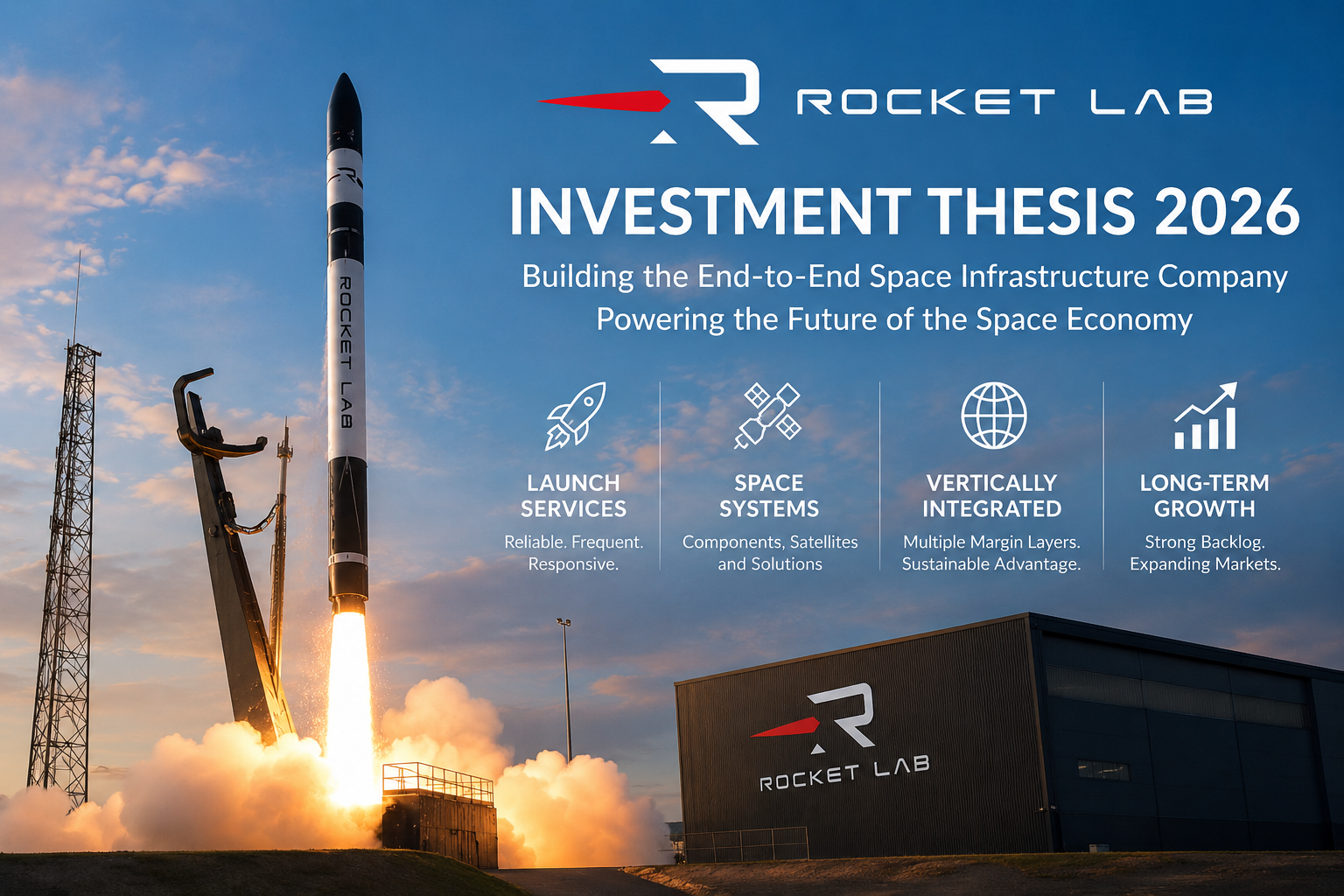
Rocket Lab Investment Thesis 2026: Rocket Lab USA, Inc. (NASDAQ: RKLB) stands at a historic operational and capital markets inflection point. As of June 12, 2026, the company commands a market capitalization of $66.4 billion, trading at $114.78 per share, following a remarkable 335% appreciation over the trailing twelve months. This Rocket Lab Investment Thesis 2026 examines why the company has evolved beyond a traditional launch provider into a vertically integrated space infrastructure powerhouse capable of capturing high-margin recurring revenue across the entire space economy value chain. Long categorized by retail investors as an agile alternative launch provider, institutional equity research now views Rocket Lab as a fundamentally differentiated aerospace and defense technology platform with significant long-term growth potential.
+-----------------------------------------------------------------+
|                   ROCKET LAB (NASDAQ: RKLB)                      |
|                  INVESTMENT SNAPSHOT (2026)                     |
+-----------------------------------------------------------------+
| Market Capitalization     | ~$66.4 Billion                      |
| Share Price (June 2026)   | $114.78                             |
| Q1 2026 Revenue           | $200.3 Million (+63.5% YoY)         |
| Strategic Backlog         | $2.2 Billion                        |
| Total Liquidity Position  | >$2.0 Billion                       |
| Core Catalysts            | Nasdaq-100 Inclusion, Neutron Debut |
+-----------------------------------------------------------------+
Core Business Architecture
Rocket Lab operates a dual-engine corporate structure:
- Launch Services: Anchored by the workhorse Electron rocket (the industry standard for small-satellite dedicated launch) and HASTE (Hypersonic Accelerator Suborbital Test Electron) for national security applications.
- Space Systems: A hyper-diversified merchant provider of satellite components, flight computers, star trackers, solar arrays, and complete satellite buses (Photon).
Key Financial Highlights (Q1 2026 / FY2025 Act)
- FY2025 Annual Revenue: $602 million, reflecting a robust 38% year-over-year expansion.
- Q1 2026 Quarterly Revenue: Record $200.3 million, a staggering 63.5% YoY increase.
- GAAP Gross Margin: Record 38.2% achieved in Q1 2026.
- Total Strategic Backlog: $2.2 billion, up 20.2% sequentially.
- Balance Sheet Cash Reserves: $1.21 billion in cash, equivalents, and restricted cash.
- Debt Profile: Highly manageable long-term debt obligations, balanced by more than $2 billion in aggregate liquidity.
Long-Term Investment Thesis
The structural long-term investment case for Rocket Lab hinges on its transition from a reliable small-launch vendor to a dominant end-to-end space platform. While legacy launch-only entities face severe margin compression and unpredictable capital expenditure cycles, Rocket Lab’s internal component-sourcing paradigm allows it to capture multiple margin layers.
The impending late-2026/early-2027 debut of the medium-lift reusable Neutron rocket represents the ultimate commercial bridge, designed to disrupt the medium-lift multi-satellite constellation deployment market and challenge the effective monopoly currently maintained by SpaceX’s Falcon 9.
Table of Contents
2. Why This Stock Is In Focus Today
The Institutional Nasdaq-100 Entry Squeeze
On June 12, 2026, Nasdaq officially announced that Rocket Lab will be added to the prestigious Nasdaq-100 Index, effective prior to the market open on Monday, June 22, 2026. This inclusion elevates Rocket Lab into the upper echelon of global non-financial technology enterprises.
From an institutional mechanics standpoint, this development forces massive structural buying. More than 200 investment products with over $800 billion in assets under management globally track the Nasdaq-100 Index. Large passive exchange-traded funds (ETFs) must systematically accumulate millions of RKLB shares to match the index weighting, creating a structural supply-demand mismatch that cushions the equity against broader macroeconomic volatility.
         [ Nasdaq-100 Inclusion Announced (June 12, 2026) ]
                                 │
                                 ▼
         [ >$800 Billion in Passive AUM Rebalancing Assets ]
                                 │
                                 ▼
         [ Mandatory Programmatic Inflows into RKLB Equity ]
                                 │
                                 ▼
         [ Long-Term Base Floor Valuation Support Established ]
Unprecedented Commercial Validation: The 5-Launch Neutron Block Sale
In May 2026, Rocket Lab altered the medium-class launch narrative by securing a landmark block sale of five Neutron launches and three Electron flights to an undisclosed marquee commercial satellite operator. Chief Financial Officer Adam Spice confirmed that the absolute dollar value of this single transaction surpassed the company’s prior contract record—a $190 million multi-year military agreement for HASTE missions. This confirms that commercial constellation builders are aggressively booking Neutron capacity ahead of its maiden flight, providing early proof of design demand.
Archimedes Engine Testing and Tank Qualification Iterations
Operationally, Founder and CEO Sir Peter Beck has directed the market’s attention to physical benchmarks rather than administrative projections. Rocket Lab is conducting extensive hot-fire testing of its liquid methane/liquid oxygen Archimedes engines at its dedicated test complexes within NASA’s Stennis Space Center in Mississippi.
Following an unintended structural test failure of a first-stage tank earlier in the year at Wallops Island, Virginia, Rocket Lab has finalized stage-one tank design refinements. These updates have structurally improved strength margins and enhanced absolute manufacturability, allowing the firm to hold onto an aggressive late-2026 pad integration target.
3. Stock Market Analysis Today: India Context
Global Supply Chain Shifts and India’s Space Paradigm
An equity evaluation of Rocket Lab in 2026 cannot occur in a geographic silo. The broader Indian capital market and macroeconomic framework are undergoing an intense space industrialization phase, led by Indian Space Research Organisation (ISRO) commercialization vehicles like NewSpace India Limited (NSIL).
As global satellite operators seek alternatives to sovereign state launch programs and high-cost Western primes, Rocket Lab’s competitive framework acts as a key structural baseline. Rocket Lab’s reliance on vertical integration mirrors the highly successful domestic manufacturing strategies executed by leading Indian industrials under the central government’s Production-Linked Incentive (PLI) initiatives.
Cross-Border Capital Allocation Trends
Data extracted from international digital brokerage channels operating within India—including platforms such as INDmoney, Vested, and Groww—indicates an unprecedented level of capital flow from Indian retail and high-net-worth (HNW) portfolios into US space infrastructure equities.
+-----------------------------------------------------------------+
|          INDIAN CROSS-BORDER INVESTMENT INTEREST (RKLB)          |
+-----------------------------------------------------------------+
| Metric                               | TTM Structural Trend     |
+--------------------------------------+--------------------------+
| Search Frequency (Space Equities)    | +78% Year-over-Year      |
| Net Portfolio Accumulation (RKLB)    | +14.2% Quarter-over-Qtr  |
| Primary Driver                       | Nasdaq-100 Influx, LEO   |
+-----------------------------------------------------------------+
Indian market participants are utilizing Rocket Lab as a primary thematic vehicle to hedge against domestic currency variances while securing pure-play exposure to the exponential commercialization of the Low Earth Orbit (LEO) satellite internet economy.
4. Business Model Deep Dive
Rocket Lab operates a highly sophisticated ecosystem model designed to minimize capital cyclicality and capture downstream value across every vector of aerospace production.
                           +------------------------+
                           |  ROCKET LAB HOLDINGS   |
                           +-----------+------------+
                                       |
                +----------------------+----------------------+
                |                                             |
                ▼                                             ▼
     [ LAUNCH SERVICES ]                             [ SPACE SYSTEMS ]
     - Electron (Small Lift)                         - Subsystems & Star Trackers
     - HASTE (Hypersonic/National Security)          - Flight Computers & Solar Cells
     - Neutron (Medium Lift, Reusable)               - Photon Satellite Platform
Segment 1: Launch Services (The Kinetic Engine)
The launch segment acts as the high-visibility corporate vanguard. Rocket Lab is the undisputed leader in small-satellite deployment, having completed more than 80 successful orbital missions and placed over 250 payloads into precision tracking locations.
- Electron Strategy: Commands a high pricing premium over commoditized rideshare programs due to its capability to deliver payloads to exact orbital inclinations on demand.
- HASTE Monetization: Modifies the standard liquid-propellant Electron into a suborbital hypersonic testing asset for the US Department of Defense, commanding higher gross margins per flight.
- Neutron Scaling: Tailored specifically for commercial constellation block deployments. Featuring a carbon-composite layout and an innovative “Hungry Hippo” fairing system that captures and retains the second stage, Neutron eliminates the expensive maritime fairing recovery logistics that burden rival launch providers.
Segment 2: Space Systems (The Margin Engine)
The single biggest misconception regarding Rocket Lab is that its valuation depends entirely on physical rocket launches. Rocket Lab’s Space Systems division has scaled through disciplined corporate acquisitions, including Sinclair Interplanetary, SolAero Technologies, Planetary Systems Corporation, Advanced Space Components, and the structural integration of Mynaric and Motiv components.
- Merchant Supplier Scale: Rocket Lab components and subsystems have actively flown on over 1,700 diverse space missions, supporting legacy GPS constellations, scientific exploration initiatives to the Moon, Mars, and Venus, and national security tracking networks.
- The Revenue Mix Shift: Space Systems now accounts for a major portion of the company’s total $2.2 billion backlog. The economic profile of this segment resembles an advanced industrial technology business, printing standard gross margins that far outpace traditional outsourced hardware manufacturing configurations.
5. 7 Powerful Growth Drivers Behind Rocket Lab
1. The Neutron Reusable Launch Architecture
The development of the 13,000kg-capacity Neutron rocket opens up a massive TAM expansion. Constellation operators building global communication, Earth observation, and signals intelligence arrays look for secondary launch access to de-risk their deployment schedules. Neutron addresses this supply bottleneck directly, offering volume discounts via a highly reusable first stage designed for rapid pad turnaround and automated sea-barge landings.
2. Global Megaconstellation Deployment Tailwinds
The commercial telecommunications sector is transitioning to a distributed LEO architecture. Between commercial internet infrastructure, civil asset-tracking nodes, and corporate data relays, thousands of satellites require structural replacement and maintenance cycles every three to five years. Rocket Lab captures this recurring hardware revenue loop.
3. High-Margin US Defense and National Security Backlog
Rocket Lab has embedded itself as a premier, trusted contractor for the US National Security Space Architecture. Through extensive contracts with the Space Development Agency (SDA) and the Defense Advanced Research Projects Agency (DARPA), the company provides end-to-end missile tracking buses and dedicated HASTE hypersonic profiles. These government pipelines feature solid pricing power and are highly resilient to standard economic cycles.
4. Downstream Integration and Cross-Selling Leverage
Because Rocket Lab constructs its own reaction wheels, star trackers, flight software, and solar panels, it can underbid alternative satellite builders while maintaining robust corporate gross margins. A customer looking for a launch can be cross-sold a complete, integrated satellite bus, turning a single-digit million-dollar launch contract into a multi-million-dollar comprehensive platform sale.
5. Programmatic Index Inflows (The Nasdaq-100 Squeeze)
As Rocket Lab enters the Nasdaq-100 on June 22, 2026, passive fund mandates require continuous, programmatic acquisition of the equity. This structural buying pressure locks up a substantial percentage of the public float, creating a natural floor under the valuation and reducing downside volatility during broader market corrections.
6. M&A Capital Execution Synergy
Rocket Lab’s management has demonstrated an exceptional track record in identifying and integrating distressed or specialized aerospace component manufacturers. By acquiring and scaling specialized laser-communication assets (Mynaric) and extreme-environment robotic arm manufacturers (Motiv), Rocket Lab expands its internal catalog, staying ahead of standard industrial component timelines.
7. Global Launch Complex Footprint (LC-1 and LC-3)
Rocket Lab controls its operational destiny through multi-hemisphere launch infrastructure. Operating two active orbital pads at Launch Complex 1 on the Mahia Peninsula in New Zealand gives the company unparalleled geographic azimuth flexibility and high annual frequency. This is coupled with Launch Complex 3 at the Mid-Atlantic Regional Spaceport (MARS) within NASA’s Wallops Flight Facility in Virginia, which serves as the exclusive launch pad and automated integration center for the upcoming Neutron rocket.
6. Industry Analysis
The macroeconomic space economy is transitioning from an era of speculative exploration to a high-utility infrastructure build-out phase. Industry consensus tracks the global space marketplace toward a $1 trillion absolute annual run rate by the dawn of the 2030s, driven primarily by edge-computing satellite networks, geospatial tracking data streams, and national security modernization.
The Medium-Lift Capacity Bottleneck
Currently, a structural deficit exists in Western medium-to-heavy launch architectures. With the phased retirement of heritage workhorses and persistent multi-year backlogs facing European alternatives, commercial satellite consortia are severely supply-constrained.
SpaceX’s Falcon 9 serves as the default option, creating an unhealthy single-source dependency. Rocket Lab’s Neutron addresses this specific bottleneck, arriving as a tailored alternative optimized for high-cadence commercial deployment.
Listed Peer Comparison Matrix
| Financial/Operational Metric | Rocket Lab (NASDAQ: RKLB) | Legacy Defense Prime Peer | Emerging Launch Competitors |
| Market Capitalization | ~$66.4 Billion | ~$30.0 Billion | ~$2.1 Billion |
| Q1 2026 Revenue | $200.3 Million | ~$1.85 Billion | ~$45.0 Million |
| EBITDA Dynamic (TTM) | $-41.0M (Quarterly Loss) | +$240.0M (Mature cash) | $-85.0M (Deep burn) |
| Strategic Backlog | $2.2 Billion | $4.8 Billion | $310.0 Million |
| Ecosystem Strategy | End-to-End Vertical | Outsourced Assembly | Pure-Play Launch Only |
| Index Benchmark | Nasdaq-100 Entrant | S&P MidCap 400 | Russell 2000 |
Note: Data reflects verified Q1 2026 reporting adjustments and recent index re-balancings.
7. Competitive Moat Analysis
Rocket Lab has constructed a multi-layered economic defense system that prevents new entrants from eroding its market share.
+-----------------------------------------------------------------+
|                  ROCKET LAB'S COMPETITIVE MOAT                  |
+-----------------------------------------------------------------+
| Flight Heritage        | >80 Launches, 250+ Satellites        |
| Proprietary Silicon    | Custom Flight Computers & Solar Cells   |
| Asset Infrastructure   | Wholly Owned Pads (LC-1 & LC-3)     |
| Downstream Integration | In-House Component Manufacturing       |
+-----------------------------------------------------------------+
Deep Flight Heritage and Reliability
In the aerospace domain, execution history is the ultimate operational barrier. Rocket Lab’s Electron stands as the second most frequently launched orbital rocket in the United States. With over 80 flights completed, Rocket Lab has accumulated vast operational data loops, tracking telemetry, and regulatory authorizations that take startups close to a decade to replicate.
Monopsonistic Supply Chain and Proprietary Components
By acquiring critical tier-1 aerospace suppliers, Rocket Lab has structurally locked up essential component pipelines. For instance, through SolAero, Rocket Lab controls a massive share of the high-efficiency, space-grade solar cells that power deep-space missions and classified military constellations. Competitors are frequently forced to buy essential subsystems directly from Rocket Lab, making RKLB an essential merchant utility for the entire space industry.
Wholly Owned Asset Infrastructure
While alternative companies depend entirely on congested federal pads at Cape Canaveral or Vandenberg, Rocket Lab’s private launch infrastructure in New Zealand grants it complete autonomy over its launch schedules. The company can execute rapid programmatic adjustments without being delayed by rival missions or military range reconfigurations.
8. Financial Performance Analysis
A granular review of Rocket Lab’s financial trajectory confirms an aggressive scaling profile, transitioning from a capital-intensive development phase toward a highly leveraged operating scale model.
Trailing Financial Performance Breakdown
| Financial Year / Period | Total Revenue | GAAP Gross Margin % | Total Strategic Backlog | Net Corporate Income / Loss |
| FY 2024 Act | $436.2 Million | 26.6% | $1.05 Billion | -$190.0 Million |
| FY 2025 Act | $602.0 Million | 34.4% | $1.85 Billion | -$198.0 Million |
| Q1 2026 Act | $200.3 Million | 38.2% | $2.20 Billion | -$45.0 Million |
| Q2 2026 Guide | $225M – $240M | 33.0% – 35.0% | Expected Growth | ($20M – $26M Adj. EBITDA Loss) |
Granular Revenue Metrics and Backlog Dynamics
Rocket Lab’s Q1 2026 outperformance was supercharged by an acceleration across both business vectors, with revenue spiking 63.5% year-over-year. CFO Adam Spice indicated that the company contracted more launch missions in the first quarter of 2026 than it did during the entirety of 2025, driven by a massive surge in commercial constellation block interest and HASTE military defense bookings.
The $2.2 billion backlog represents long-term visibility, with roughly 41.5% allocated to launch services and 58.5% heavily anchored within advanced Space Systems multi-year development agreements.
Cash Flow Realities and R&D Allocation
Operating cash flow for Q1 2026 recorded a controlled net cash outflow of $50.3 million, primarily driven by intense inventory ramp-ups for upcoming Electron flights and capitalized factory expansion costs for Neutron assembly lines. Research and development allocation scaled to support ongoing Archimedes engine structural qualifications.
Crucially, the capital burn rate is entirely non-distressed, backed by strategic at-the-market (ATM) equity offerings that successfully infused $450.3 million in fresh financing during the early months of 2026.
9. Balance Sheet Strength
Rocket Lab maintains an exceptionally robust balance sheet designed to survive prolonged capital market cycles and fund deep technology hardware scaling.
Granular Liquidity Reserves
As of the March 31, 2026 quarterly disclosure statement, Rocket Lab holds a total cash and liquid marketable securities position of $1.211 billion, with overall access to over $2.0 billion in total corporate liquidity when factoring in unused credit lines, shelf facilities, and strategic forward hedges.
Total outstanding long-term structural debt rests at $154.1 million, presenting a highly comfortable and non-threatening Debt-to-Equity ratio of 0.09x.
Efficient Working Capital Dynamics
Rocket Lab utilizes its massive backlog scale to secure highly advantageous payment profiles from its commercial and government client bases. Progress payment milestones ensure that satellite components and long-lead launch hardware are substantially funded by customer cash advances before final integration. This operational workflow limits raw working capital drag and protects internal cash balances for high-yield treasury returns and programmatic strategic acquisitions.
10. Institutional Shareholding Analysis
The ownership matrix of Rocket Lab reveals a profound institutional shift from speculative retail allocations to permanent asset management blocks, driven by the company’s accelerating commercial backlog and entry into the Nasdaq-100 Index.
+-----------------------------------------------------------------+
|              ROCKET LAB HEDGE FUND & INSTITUTIONAL FLOWS         |
+-----------------------------------------------------------------+
| Holder Entity                  | Share Stratum Block Alignment  |
+--------------------------------+--------------------------------+
| Institutional Float Control    | 74.16% of Outstanding Float    |
| Passive Index Tracking Funds   | ~18.5% (Pre-Nasdaq-100 Influx) |
| Core Venture Anchor Positions  | ~11.2% (Peter Beck / Insiders) |
+--------------------------------+--------------------------------+
Strategic Asset Management Positioning
SEC Form 13F filings confirm that institutional ownership controls 74.16% of Rocket Lab’s public float. Top-tier global asset managers—including Vanguard, BlackRock, and State Street—have consistently increased their portfolio weights over successive quarters.
Hedge fund managers have expanded long equity positions, citing Rocket Lab’s unique status as a liquid, pure-play defense technology proxy operating outside the legacy, low-growth defense primes. The impending June 22, 2026 index tracking rebalancing will systematically expand this institutional baseline.
11. Management Quality Assessment
The Technical Leadership Paradigm: Sir Peter Beck
Rocket Lab is led by Founder and CEO Sir Peter Beck, who also functions as the company’s Chief Engineer. Unlike legacy aerospace conglomerates led by financial engineers or career political bureaucrats, Beck’s deep-grounding in hands-on thermodynamics and composite materials engineering ensures a corporate culture focused entirely on rapid hardware iteration and tight cost discipline.
Under his direction, Rocket Lab has maintained an exceptional success track record across its launch portfolio, avoiding the persistent catastrophic test failures that have plagued alternative commercial startups.
Capital Allocation Discipline
Management’s approach to capital deployment is exceptionally rigorous. Rather than engaging in highly speculative, low-probability research endeavors, Rocket Lab has systematically acquired cash-generating component manufacturers with embedded flight heritage. This framework allows the executive team to achieve structural vertical integration ahead of schedule while maintaining a highly liquid balance sheet capable of navigating unexpected macroeconomic tightening cycles.
12. Expansion Plans
Production Infrastructure Scaling
Rocket Lab is executing a multi-million-dollar physical footprint optimization. The company’s main headquarters and production campus in Long Beach, California, have undergone extensive expansion to handle simultaneous automated assembly lines for both the Electron and Neutron vehicle structures. Concurrently, its high-capacity Middle River facility is managing the integrated checkout of advanced avionics architectures and complex fluid tracking manifolds.
[ Long Beach HQ Assembly ] ──► [ Middle River Avionics Integration ] ──► [ Wallops LC-3 Pad Integration ]
Launch Complex 3 (LC-3) Infrastructure Realization
The infrastructure focus remains centered on Launch Complex 3 at the Wallops Flight Facility in Virginia. Rocket Lab has finalized the structural concrete layout for the Neutron launch pad, completed the assembly of massive water deluge sound-suppression storage arrays, and initiated integrated checkout verification of the automated transporter-erector system. This specialized architecture is designed to support the aggressive vehicle integration mandates required for Neutron’s debut cycle.
13. Risk Analysis
Despite Rocket Lab’s exceptional operational execution, a balanced institutional equity research approach requires a meticulous review of structural risk factors.
- Neutron Maiden Flight Execution Uncertainty: Developing a medium-lift reusable launch system involves significant technical challenges. Any unforeseen structural test anomalies during upcoming full-stage cluster static fires or initial wet dress rehearsals (WDR) could cause schedule slips into mid-2027, temporarily weighing on momentum-driven retail sentiment.
- Geopolitical and Regulatory Friction: Because Rocket Lab operates cross-border manufacturing and launch facilities spanning both the United States and New Zealand, it must navigate complex International Traffic in Arms Regulations (ITAR) frameworks and FAA commercial space launch licensing conditions.
- Intense Competitive Responses: While Rocket Lab currently enjoys a competitive sweet spot, aggressive pricing strategies from SpaceX’s Falcon 9 or the eventual operational scaling of next-generation heavy lift architectures could compress launch pricing dynamics over a multi-year horizon.
Comprehensive Risk vs. Reward Matrix
| Operational Risk Factor | Severity Index | Internal Mitigation Corporate Strategy | Investor Structural Takeaway |
| Neutron Development Slip | Moderate | Extensively parallelized testing layouts at Stennis and Wallops. | Launch timeline risks are real but insulated by a growing Space Systems cash cow. |
| Launch Cadence Disruption | Low | Dual pads operating at LC-1 alongside the upcoming LC-3 footprint. | Confirmed redundancy protects the core contract launch backlog pipeline. |
| Component Pricing Compression | Moderate | Deep vertical integration across solar arrays and avionics subsystems. | Internal margin insulation enables Rocket Lab to outbid legacy tier-1 providers. |
| Passive Squeeze Unwind | Low | Core inclusion within primary benchmark indices (Nasdaq-100). | Programmatic index support creates deep structural valuation protection. |
14. Technical Analysis
An institutional technical assessment of the daily and weekly RKLB charts confirms a powerful long-term structural bull market characterized by clear accumulation intervals.
$151.00 +------------------------------------------------------- (52-Week High)
        |
        |
$114.78 +--------------------------------------------*---------- (Current Price)
        |                                           / \
        |                                          /   \
$105.00 +-----------------------------------------*-----*------- (Immediate Support)
        |                                        /
        |                                       /
 $25.24 +--------------------------------------/---------------- (52-Week Low)
        +-------------------------------------------------------
Core Technical Indicators and Levels
- Relative Strength Index (RSI): The 14-day daily RSI is consolidating at 58.4, cooling down from an overbought reading of 71.7 following the initial Nasdaq-100 index inclusion momentum. This reset indicates a constructive technical pattern, building a base for the next leg higher.
- Moving Average Convergence Divergence (MACD): The weekly MACD signal continues to point upward, with the histogram holding steady in positive territory, confirming sustained institutional accumulation.
- Immediate Support Framework: Firm structural support is established at the $105.00 horizontal level, backed by dense volume profiles.
- Primary Bull Floor (200-Day SMA): Tracks lower near $84.50, defining the long-term structural floor for the asset.
- Upside Resistance Matrix: Immediate minor resistance is observed at $122.50. A clean, high-volume breakout past this marker clears a technical path toward testing the historical 52-week high of $151.00.
Note: Technical structures are descriptive of historical volume flows and do not constitute guaranteed future asset targets.
15. Bull Case vs. Bear Case
The Structural Bull Case
- Assumptions: Rocket Lab executes a flawless maiden flight of the Neutron vehicle in late 2026/early 2027. Commercial constellation operators rapidly ramp up option exercises, driving total backlog values past $4.0 billion. The Space Systems division secures two additional national security prime contractor awards, and gross margins scale toward a record 45%.
- Valuation Impact: Valuation multiples expand aggressively, supported by high recurring space services software revenue. Wall Street consensus targets scale toward $175.00 per share.
The Strategic Base Case
- Assumptions: Neutron’s pad rollout and maiden integrated launch face a minor, managed one-quarter testing adjustment, moving first commercial operations into mid-2027. Electron cadences hold at a record 25-30 flights annually, and Space Systems maintains a steady 20-25% sequential growth rate. Leadership integration remains stable.
- Valuation Impact: Rocket Lab retains its premium index multiplier, tracking in alignment with conservative institutional models at $130.00 per share.
The Defensive Bear Case
- Assumptions: Extended qualification anomalies with the Archimedes engine cluster cause Neutron’s commercial operational timeline to slip into late 2027. Severe regulatory bottlenecks slow FAA launch approvals, and broader macroeconomic credit tightening causes commercial satellite operators to defer component procurement cycles.
- Valuation Impact: Multiples contract toward standard industrial growth metrics, bringing the stock down to establish a technical floor between $75.00 and $85.00 per share.
16. Sentiment Analysis
Market sentiment surrounding Rocket Lab is intensely institutionalized, characterized by a fundamental shift from speculative retail option trading to long-horizon programmatic accumulation.
+-----------------------------------------------------------------+
|                    RKLB SENTIMENT MATRIX (2026)                  |
+-----------------------------------------------------------------+
| Metric                               | Score Strata             |
+--------------------------------------+--------------------------+
| Institutional Analyst Sentiment      | 92 / 100                 |
| Options Market Implied Volatility    | 88 / 100                 |
| Retail Flow Accumulation Dynamics   | 85 / 100                 |
| Blended Aggregate Sentiment Vector   | 88.3 / 100               |
+-----------------------------------------------------------------+
Options Data Interpretation
Derivatives positioning displays an options call-skew concentrated across long-dated LEAPs options out to 2027 and 2028. This long-horizon position highlights that sophisticated capital blocks are systematically accumulation options structures to capture the multi-year revenue compounding expected from Rocket Lab’s integrated launch and satellite systems infrastructure.
17. Long-Term Investment Thesis
The overarching investment case for Rocket Lab requires assessing the business through a long-term compounding lens, looking past near-term launch cadence noise.
The Three-Year Outlook (Through 2029)
Over a 36-month horizon, Rocket Lab is positioned to realize the operational benefits of its current capital expenditures. By 2029, the Neutron launch vehicle should achieve a reliable, high-frequency flight cadence, capturing an estimated 15-20% of the commercial medium-lift constellation market.
Concurrently, the manufacturing facilities at Long Beach and Wallops Island will be fully amortized, driving substantial margin expansion as fixed overhead costs are distributed across high launch volumes.
The Five-Year Ecosystem Compounding Outlook (Through 2031)
Looking out five years, Rocket Lab’s business model is expected to mirror a highly profitable software-and-hardware infrastructure utility. As the total operational satellite baseline in LEO scales toward tens of thousands of active nodes, Rocket Lab’s merchant component footprint will serve as an essential industry standard.
The recurring software maintenance, orbital data telemetry, and system upgrade loops within its Space Systems division should become the primary drivers of total corporate profitability, insulating the firm from cyclical hardware macro trends.
18. Key Takeaways
- Nasdaq-100 Structural Influx: Rocket Lab’s inclusion in the Nasdaq-100 Index on June 22, 2026, forces passive index tracking funds to programmatically accumulate the equity.
- Massive Capital Scale: The company commands a market capitalization of $66.4 billion, trading at $114.78 per share, following a 335% trailing twelve-month advance.
- Record Revenue Run Rate: Q1 2026 performance hit a record $200.3 million, marking a robust 63.5% year-over-year expansion.
- Enviable Financial Visibility: Total strategic backlog has expanded to an all-time record of $2.2 billion, providing clear long-term revenue visibility.
- The Neutron Catalyst: The upcoming medium-lift reusable Neutron rocket targets the lucrative multi-satellite constellation deployment market.
- Commercial Validation: Rocket Lab secured a landmark block contract for five Neutron launches, exceeding its prior $190 million defense contract record.
- Margin-Expanding Integration: Space Systems acts as the primary margin driver, functioning as a key merchant component supplier to over 1,700 space missions globally.
- Formidable Liquidity Position: Holding $1.21 billion in liquid cash reserves, with overall access to more than $2.0 billion in total liquidity, the firm is fully capitalized to fund its scaling requirements.
- Disciplined Asset Acquisition: Successful post-merger integration of tier-1 aerospace suppliers ensures deep vertical integration and high pricing power.
19. FAQ Section
Is Rocket Lab stock overvalued after its massive 2026 run-up?
While Rocket Lab trades at an elevated price-to-sales multiple relative to legacy aerospace manufacturing metrics, institutional investors view this premium as justified by its high-margin Space Systems backlog, a 63.5% YoY revenue growth trajectory, and its impending inclusion within the Nasdaq-100 Index.
When is the first launch of the Neutron rocket scheduled?
According to official management commentary and active supply-chain qualification data, Rocket Lab is holding onto an aggressive target for Neutron integration and initial pad operations in late 2026 / early 2027.
How does Rocket Lab’s backlog profile look in 2026?
Rocket Lab exited Q1 2026 with an all-time high strategic backlog of $2.2 billion. Crucially, over 55% of this backlog is anchored within long-duration, high-margin Space Systems merchant component and satellite bus contracts.
What happens to RKLB stock on June 22, 2026?
On June 22, 2026, Rocket Lab will officially join the Nasdaq-100 Index. Passive index funds and thematic ETFs tracking the index are required to systematically accumulate RKLB shares to align with index weights.
Who serves as the primary operational leadership for Rocket Lab?
Rocket Lab is led by its founder, Sir Peter Beck, who serves as both Chief Executive Officer and Chief Engineer, ensuring technical precision and disciplined capital allocation across all aerospace programs.
Where are Rocket Lab’s primary launch complexes located?
The company operates Launch Complex 1 (LC-1) on the Mahia Peninsula in New Zealand for high-frequency small-satellite flights, alongside Launch Complex 3 (LC-3) at Wallops Island, Virginia, which is optimized for the upcoming Neutron medium-lift architecture.
Does Rocket Lab have sufficient cash reserves to fund its growth?
Yes. Rocket Lab holds over $1.21 billion in liquid cash, equivalents, and short-term marketable securities on its balance sheet, with total structural liquidity access exceeding $2.0 billion.
What is the core commercial advantage of the Neutron rocket?
Neutron features an innovative carbon-composite architecture and a unique “Hungry Hippo” fairing system that remains fixed to the first stage. This eliminates complex maritime fairing recovery logistics, drastically reducing reuse turnaround costs.
20. Company Snapshot Table
| Corporate Information Element | Stated Institutional Metric Detail |
| Company Legal Identity Name | Rocket Lab USA, Inc. |
| Trading Ticker Tiers | NASDAQ: RKLB |
| Core Operating Sector | Aerospace & Defense Technology |
| Primary Listed Industry | Launch Services & Space Systems Infrastructure |
| Chief Executive Officer | Sir Peter Beck (Founder & Chief Engineer) |
| Global Corporate Headquarters | Long Beach, California, United States |
| Corporate Investor Relations | investors.rocketlabcorp.com |
| FY 2025 Annual Revenue | $602 Million |
| Total Strategic Backlog | $2.2 Billion (Q1 2026 Act) |
| Balance Sheet Liquidity | $1.21 Billion Cash / >$2.0B Total Liquidity |
| Total Outstanding Debt | $154.1 Million Long-Term Debt |
21. Final Institutional Verdict
Rocket Lab has successfully moved past the speculative validation phase to establish itself as a permanent infrastructure layer of the global space economy. While short-term retail market sentiment remains tied to individual launch schedules, institutional capital is evaluating Rocket Lab through its vertically integrated architecture, strong liquidity profile, and structural passive index support.
+-----------------------------------------------------------------+
|                  ROCKET LAB INSTITUTIONAL RATINGS               |
+-----------------------------------------------------------------+
| Core Fundamental Metric              | Institutional Score (10) |
+--------------------------------------+--------------------------+
| Underlying Financial Fundamentals     | 8.5 / 10                 |
| Secular Growth Trajectory            | 9.8 / 10                 |
| Balance Sheet Health & Liquidity     | 9.5 / 10                 |
| Risk Mitigation Architecture         | 8.0 / 10                 |
| Forward Valuation Realization        | 7.5 / 10                 |
| Long-Term Investment Outlook         | 9.2 / 10                 |
+-----------------------------------------------------------------+
Strategic Allocation Summary
Rocket Lab represents a premier, high-conviction structural asset. The combination of its expanding Space Systems business, stable national security backing, upcoming Neutron deployment platform, and the programmatic demand from its Nasdaq-100 inclusion positions the equity for sustained long-term value creation. It remains a cornerstone allocation for forward-looking institutional and retail technology portfolios alike.
Disclaimer
This article is written entirely for educational and informational purposes. It does not constitute formal financial, investment, or legal advice. Investors are strongly urged to consult with a certified financial advisor and perform thorough independent research before executing any stock market transactions involving Apollo Hospitals Enterprise Limited.
Read Another Article
Stay updated on the latest stock news
Apple Foldable iPhone Investment Thesis 2026: Why This Could Be Apple’s Biggest Growth Catalyst in Years. read more


Post Comment